Definition
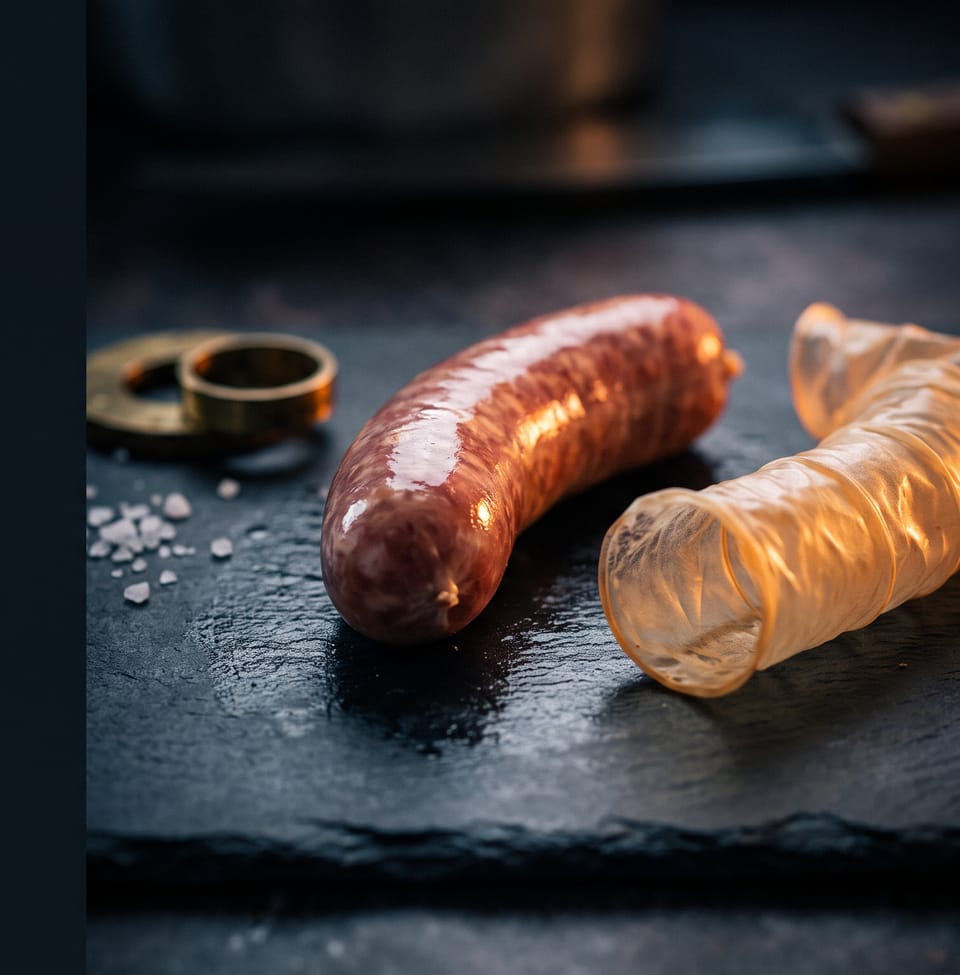
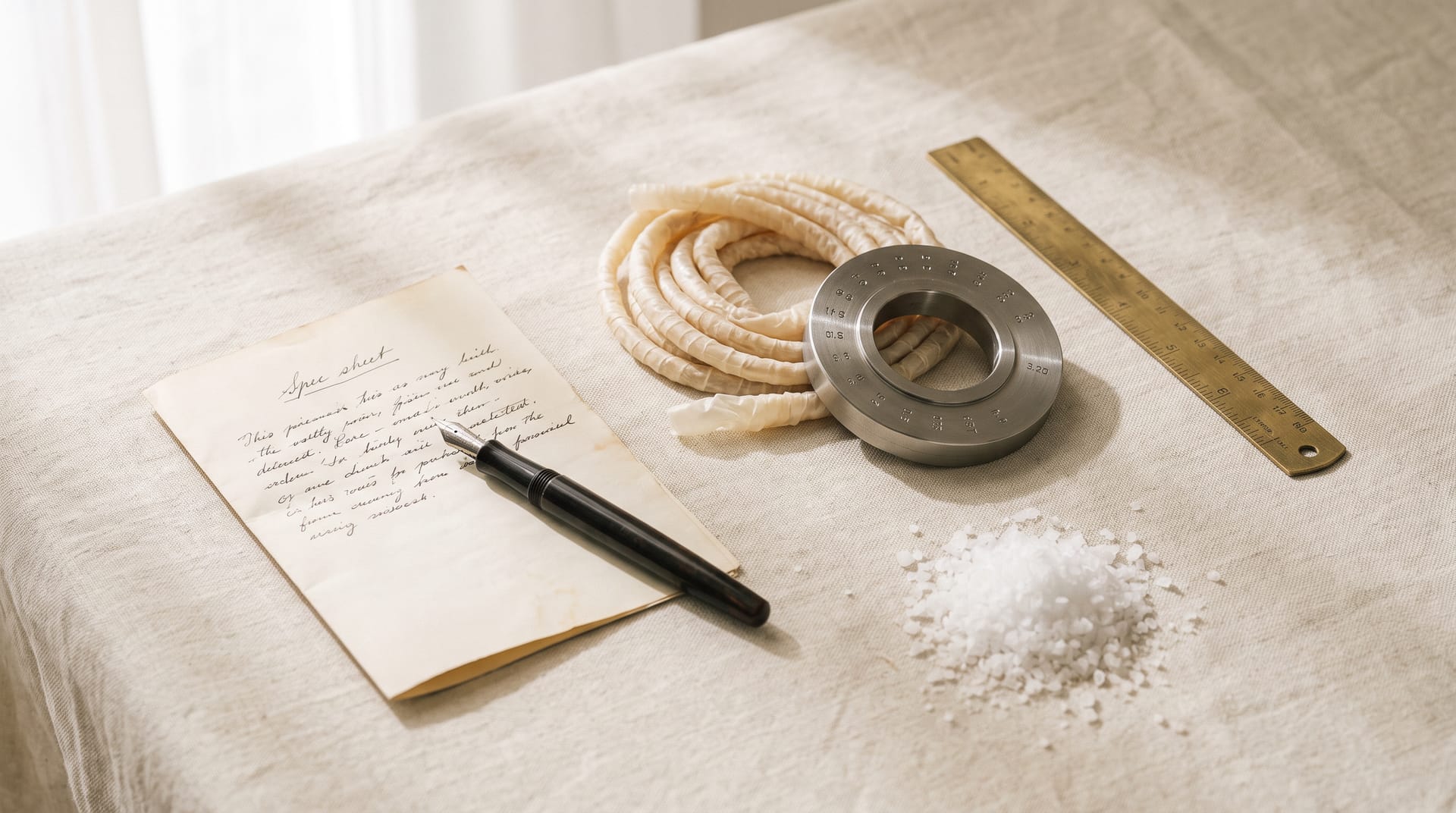
Calibre is the inner diameter of a natural casing in millimetres, measured when the casing is filled, and expressed as a class of two numbers, for example 28/30. The first number is the lower limit and the second the upper limit of the class. A 28/30 casing therefore measures between 28 and 30 mm.
How calibre is measured
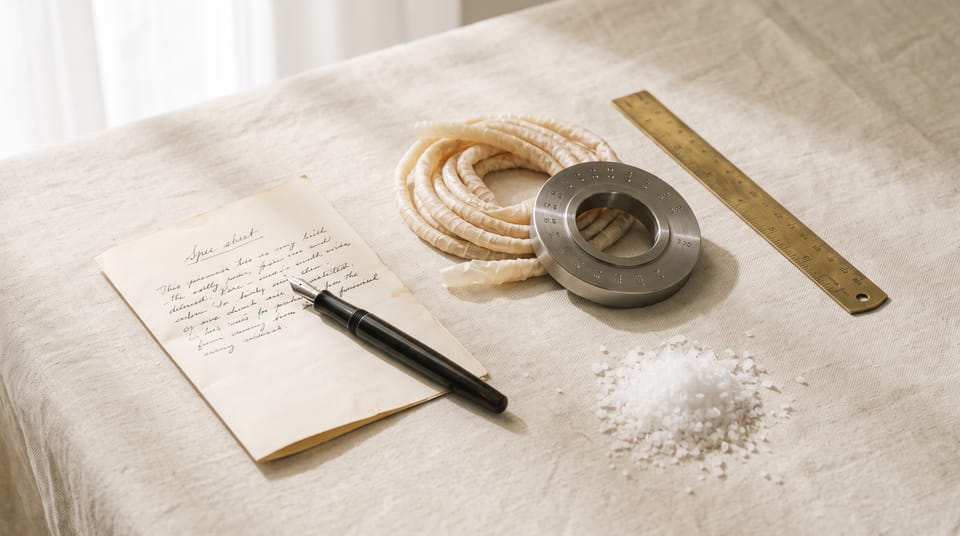
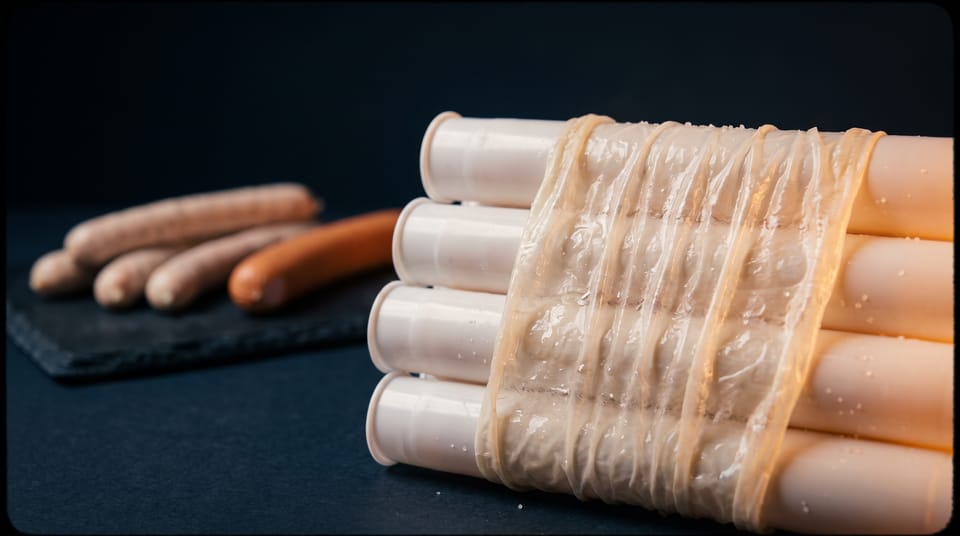
During selection, the desalted casing is filled with water or air and passed over a gauge, a plate or a set of rings in 2 mm steps. The operator reads the step at which the filled casing fits and cuts or sorts accordingly. The measurement is taken on the casing, not on the finished sausage. Because a soaked casing stretches under filling pressure, the stuffed product is usually 1 to 3 mm wider than the nominal class. Allow for this when working back from a target sausage diameter.
Two numbers describe the result of selection:
- The class (28/30, 32/34, 40/42) is the 2 mm range into which the casing falls.
- The selection tolerance (2 mm or 2/4 mm) describes how strictly a lot is sorted and sold. A 2 mm selection ships casings in a single 2 mm class. A 2/4 mm selection sorts in 2 mm classes and may combine two neighbouring classes into a 4 mm class, such as 32/36, where the application allows it.
Teijsen selects hog casings to a 2/4 mm tolerance and sheep casings to 2 mm as standard, in our own facility in Shaoshan. Tighter selections are produced on request. The tolerance is stated on every specification, and the inbound check in Zeewolde measures each lot against it; see the quality page.
Typical calibres per sausage type
The table shows typical calibre classes per sausage type and species. They are industry conventions, not fixed rules: recipes, regional preferences and pack formats shift the choice by one class in either direction.
| Sausage type | Species | Typical calibre | Market |
|---|---|---|---|
| Chipolata, breakfast sausage | Sheep | 18/20 to 22/24 mm | UK, France |
| Nürnberger Rostbratwurst | Sheep | 20/22 to 22/24 mm | Germany |
| Frankfurter, Wiener | Sheep | 20/22 to 24/26 mm | Germany, Austria, US |
| Merguez | Sheep | 20/22 to 24/26 mm | France, North Africa |
| Hot dog (natural casing) | Sheep | 22/24 to 26/28 mm | US |
| Bratwurst, Thüringer | Hog | 28/30 to 32/34 mm | Germany |
| Fresh sausage, Toulouse, Cumberland | Hog | 30/32 to 34/36 mm | France, UK, NL |
| Chorizo, salchicha | Hog | 32/34 to 38/40 mm | Spain, Latin America |
| Linguiça, chouriço | Hog | 30/32 to 36/38 mm | Portugal, Brazil |
| Pepperoni, Italian sausage | Hog | 32/34 to 38/40 mm | US, Italy |
| Weisswurst, Bockwurst | Hog | 34/36 to 40/42 mm | Germany |
| Fleischwurst, kielbasa, black pudding | Beef rounds | 35 to 46 mm+ | Germany, Poland, UK |
| Salami, cervelat, Zungenwurst | Beef middles | 45 to 60 mm+ | Germany, Switzerland, Italy |
| Mortadella, large salami, liver sausage | Beef caps | 90 to 120 mm+ | Italy, Germany |
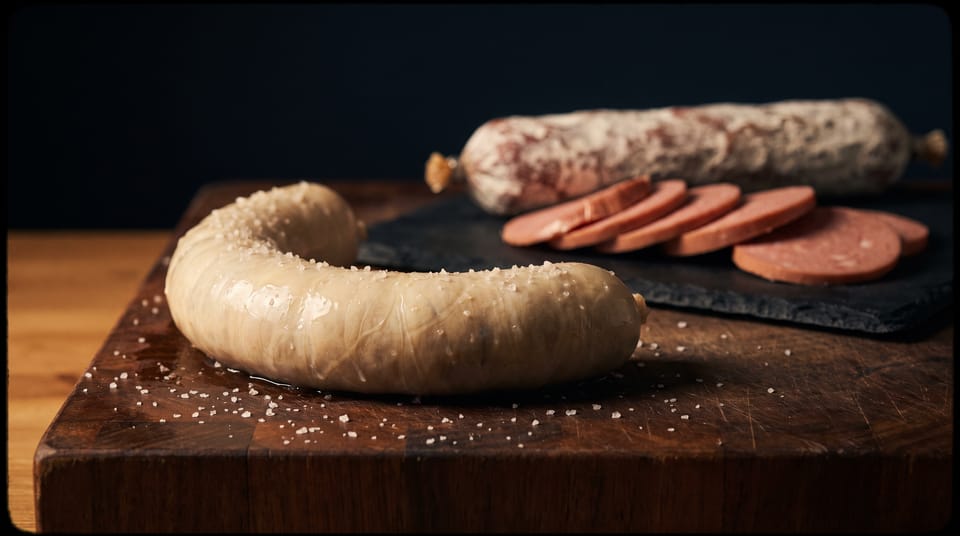
Beef calibres are usually stated as single ranges rather than 2 mm classes because the products are sliced or portioned rather than sold by piece. See the beef casings page for the full range of rounds, middles and caps.
How to pick a calibre for a filling line
- Start from the finished product. Measure the diameter of the sausage you sell, or the diameter your customer specifies. Subtract 1 to 3 mm for stretch to arrive at the casing class.
- Check the stuffing horn. The casing has to slide onto the horn and run off it without tearing. Horn diameter is typically 4 to 8 mm below the casing calibre; your machine supplier states the fit for each horn.
- Work out piece weight. Filling weight per centimetre rises with the square of the diameter. Moving one class up, from 28/30 to 30/32, adds roughly 12 to 15 % to the weight of a sausage of the same length. For fixed-weight packs this is the fastest lever you have; the figures are illustrative and depend on your recipe density.
- Match tolerance to the pack format. Loose, weighed sausage tolerates a 2/4 mm selection. Fixed-count packs with a declared weight benefit from a 2 mm or tighter selection, because every millimetre of variation shows up as give-away or short weight.
- Decide the length class. Longer ends mean fewer stops; see why long-end casings pay back. On a hand-linked line, standard lengths are often sufficient.
- Run a sample. Order a sample in the calibre you calculated and in the neighbouring class. Run both on your line with your recipe, weigh ten pieces of each, and choose. Samples in your calibre ship within days.
Common mistakes
Ordering by sausage diameter instead of casing calibre. A 32 mm finished product usually needs a 30/32 or 28/30 casing, not a 32/34.
Mixing species to hit a calibre. A 26/28 sheep casing and a 26/28 hog casing have the same diameter but a different wall, bite and price. Read hog, sheep or beef casings before switching.
Ignoring the tolerance on the specification. Two lots labelled 32/34 can behave differently if one was selected to 2 mm and the other to 2/4 mm. Specify the tolerance you need, and check the inbound lot against it.
Forgetting preparation. An under-soaked casing fills narrower and tears; an over-soaked casing fills wider than the class suggests. The preparation guide gives typical soaking ranges.
Last updated: 5 October 2026