Definition
A long-end casing is a natural casing selected for length as well as calibre, so that each end, the continuous piece of casing between two cuts, is long enough to run through many sausages before the line has to reload. For sheep casings the long-end classes are typically 7, 10, 13 and 16 metres and more; for hog casings the XXL class is 14 metres and more per end. Length is a result of selection: the longer the piece, the fewer holes and weak spots it contained, and the more carefully it was handled from the slaughter plant onwards.
Where the time goes on an automatic line
An automatic filling and linking line is a continuous process. The stuffer pushes filling through the horn, the casing is drawn off the horn as it fills, and the linker twists or crimps the string into portions. The process is interrupted only when the casing runs out. At that moment three things happen.
The line stops. The operator removes the empty tube or threads the next end, restarts and brings the line back to speed. On a hand-threaded salted casing this takes a minute or more; on a soft tube, seconds.
A tail is produced. The last portion of each end is incomplete and goes back as rework, and the first portion of the next end often does too. The tail is roughly the same size whatever the length of the end.
Attention is diverted. While the operator reloads, nobody watches calibre, weight and seal. Short ends multiply the moments in which quality can drift.
All three scale with the number of ends per shift, not with the number of metres. That is the whole argument for long-end material: the same metres, in fewer pieces.
The arithmetic
Take a line that consumes 500 metres of casing per hour. The figures below are illustrative and assume one reload per end and no breakage.
| Length per end | Ends per hour | Reloads per 8-hour shift | Tails per shift |
|---|---|---|---|
| 5 m (standard hank) | 100 | 800 | 800 |
| 7 m | about 71 | about 571 | about 571 |
| 10 m | 50 | 400 | 400 |
| 14 m (XXL hog) | about 36 | about 286 | about 286 |
| 16 m (long-end sheep) | about 31 | about 250 | about 250 |
Moving from 5 metre to 14 metre ends removes around 500 reloads from a shift. Multiply by your own reload time and tail weight to see what that is worth on your line; at one minute per reload, it is more than eight hours of line time per shift recovered, which is why many high-volume producers treat length class as seriously as calibre. Your actual gain depends on your current length class, line speed, make-up and breakage rate. None of these figures is a Teijsen guarantee; they are a way to do your own sums.
Yield effects
Fewer tails means less rework, and rework is not free: the filling is handled twice, often chilled and re-ground, and in some products it cannot be re-used at all. Long ends also fill more evenly, because the line spends more of its time at steady state rather than accelerating after a restart, which narrows the weight distribution of the finished sausages and reduces give-away in fixed-weight packs. On a sheep-casing hot dog or frankfurter line, where the casing is thin and the portions small, the steady-state effect is often as valuable as the reload saving.
Long ends and soft tubes together
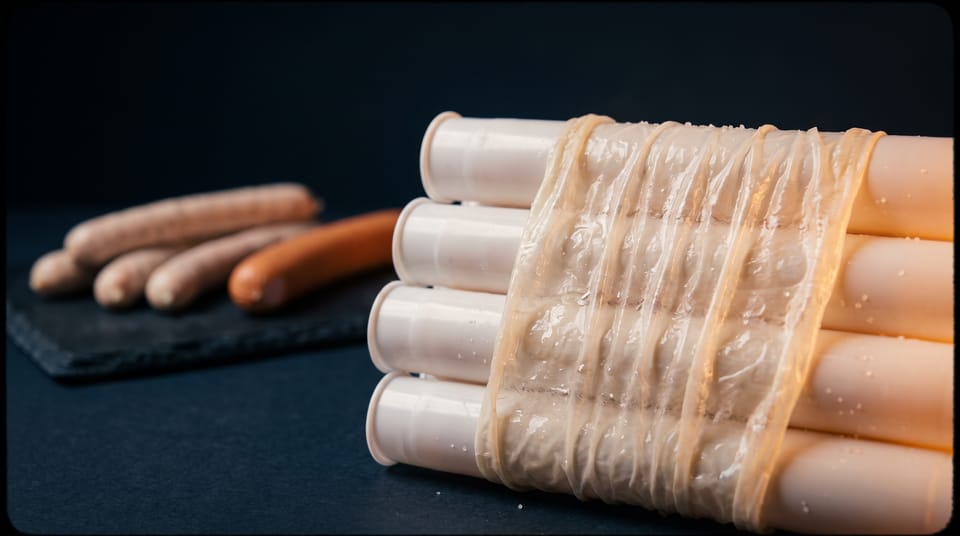
Long-end material delivers the most on soft tubes. A 14 metre XXL hog end or a 16 metre sheep end shirred on a tube loads in seconds, has already been rinsed, and runs through without a single threading operation. The combination is the standard for automatic sheep-casing lines and increasingly for hog-casing lines. See soft tubes versus salted bundles for the full comparison.
A long-term customer in Finland puts the result in one sentence: the 14 metre and more hog casings on soft tubes work fantastically in their automatic filling line. That is the experience Teijsen builds its selection around.
How Teijsen produces long-end material
Length sorting is a separate step in our selection facility in Shaoshan, after calibre grading. Every end is measured, and XXL hog casings of 14 metres and more are separated from traditional lengths; sheep casings are sorted into 7, 10, 13 and 16 metre and more classes, selected to 2 mm and graded AA, A or AB. The length class is stated on the specification and checked again on arrival in Zeewolde under IFS Food Higher Level; see the quality page. Traditional lengths remain in the range for lines and recipes that do not need long ends.
How to test it on your own line
- Note your current length class, reloads per shift, reload time and tail weight for one week.
- Request a sample of long-end material in the same calibre, on soft tubes if your stuffer accepts them.
- Run the sample for a full shift under normal conditions and record the same four figures.
- Compare cost per metre against recovered line time and reduced rework.
- Decide per product line. Many producers specify long-end for their automatic lines and standard lengths for hand-linked specialities.
If you are choosing calibre at the same time, read the calibre guide first, because length and calibre are specified together.
Last updated: 5 October 2026