Definition
A natural casing is the submucosa of an animal intestine, cleaned of its other layers, preserved in salt and sorted by calibre and length so that it can be used as the skin of a sausage. The submucosa is the connective-tissue layer of the gut wall. It is thin, strong and elastic, and it is this layer, not the whole intestine, that ends up on your stuffing horn.
Three species, five casing types
Natural casings come from three species. Each gives a different calibre range and a different eating quality.
Hog casings are the small intestine of the pig. Calibres run from about 26/28 mm to 44/46 mm. They are the standard casing for bratwurst, fresh sausage, Toulouse, chorizo and many cooked sausages. See the hog casings page.
Sheep casings are the small intestine of sheep and lambs. Calibres run from about 16/18 mm to 26/28 mm. They are the thinnest and most tender natural casing, used for breakfast sausage, chipolata, Nürnberger, merguez and frankfurters. See the sheep casings page.
Beef casings come in three types. Rounds are the small intestine, roughly 35 to 46 mm and more, used for ring sausages such as Fleischwurst, kielbasa and black pudding. Middles are the large intestine, roughly 45 to 60 mm and more, used for salami and cervelat. Caps (bungs) are the caecum, roughly 90 to 120 mm and more, used for mortadella, large salami and liver sausage. See the beef casings page.
How a casing is processed
The route from slaughter plant to salted bundle is largely the same for every species. The steps below describe generally accepted industry practice; the exact sequence varies by plant.
- Pulling and emptying. The intestine is separated from the mesentery at the slaughter line and emptied of its contents, usually within an hour of slaughter.
- Stripping (sliming). The mucosa on the inside and the serosa and muscle layers on the outside are removed, mechanically or by hand, leaving the submucosa. This is the step that decides wall strength and the presence of whiskers, the small remnants of connective tissue on the outer surface.
- Cleaning and cooling. The stripped casing is rinsed and cooled. Any holes, weak spots or fat remnants are cut out.
- Salting. The casing is salted with dry salt or in a saturated brine, which draws water out of the wall and preserves it. A green-salted casing can be stored and transported before selection.
- Selection (grading). The casing is desalted, measured and sorted. Calibre is measured by filling a section with water or air and comparing the diameter against a gauge, in 2 mm steps. Length is sorted into classes, for example standard and long-end. Quality grades such as A, AA or AB describe cleanliness, strength and the absence of holes. At Teijsen this step takes place in our own facility in Shaoshan, China; the standard tolerance is 2/4 mm for hog casings and 2 mm for sheep casings.
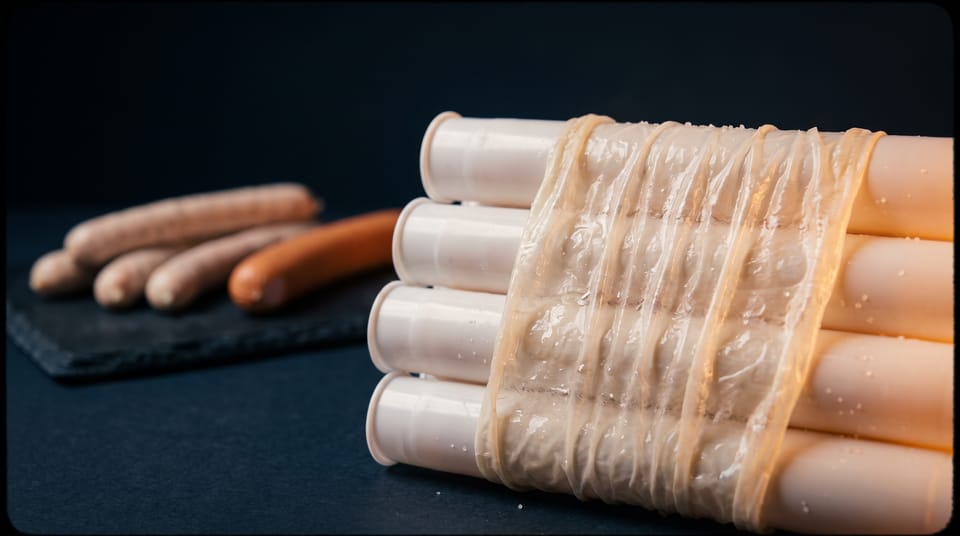
- Make-up and re-salting. The selected casing is tied into hanks of a stated total length, put on soft tubes or packed loose for easy fill, then re-salted and packed in barrels, E2 crates or buckets. Read more in soft tubes versus salted bundles.
- Inspection and shipping. Every lot is checked against its specification before shipping. At Teijsen this happens in Zeewolde under IFS Food Higher Level; see the quality page.
Natural versus collagen, cellulose and plastic
Artificial casings exist for good reasons: uniform diameter, high line speeds and no soaking. The differences that matter on the plate and on the line are summarised below.
| Property | Natural casing | Collagen casing | Cellulose casing | Plastic casing |
|---|---|---|---|---|
| Material | Animal intestine (submucosa) | Extruded bovine collagen | Regenerated cellulose | Polyamide or similar polymer |
| Edible | Yes | Edible and non-edible grades | No, peeled before sale | No, peeled before sale |
| Bite | Characteristic snap | Softer, uniform | None (peeled) | None (peeled) |
| Smoke and moisture permeability | High | Moderate | High | Low or none |
| Shape | Natural curve | Straight | Straight | Straight |
| Calibre uniformity | Selected to 2/4 mm or 2 mm steps | Very uniform | Very uniform | Very uniform |
| Preparation | Desalting and soaking | None or short soak | None | None |
Three of these differences explain why premium and traditional sausage producers specify natural casings.
Bite. The submucosa is a dense collagen network that tightens during cooking and smoking. It gives the snap consumers associate with a good bratwurst or frankfurter, which a collagen casing imitates only partly.
Permeability. Natural casing walls let smoke, moisture and flavour pass. A smoked sausage in natural casing takes colour and taste through the whole surface, and a dried sausage loses water evenly. Plastic casings block this exchange entirely, which is why they are limited to cooked, unsmoked products.
Curve. Because the intestine is not a perfect cylinder, the stuffed sausage curves. For many markets, from German bratwurst to Spanish chorizo and Portuguese linguiça, that curve signals an artisan product.
The cost of variation
The same biology that gives bite and curve also gives variation. Calibre, wall thickness and length differ from animal to animal and from plant to plant. This is why selection is the decisive step in the chain, and why a tight tolerance, a clear quality grade and a reliable length class matter more than the species name on the label. The calibre guide explains how calibre is measured and chosen, and hog, sheep or beef casings helps you choose between species. To judge for yourself, request a sample in your calibre.
Last updated: 5 October 2026