Definition
Casing preparation is the sequence of desalting, soaking, rinsing and resting that brings a dry-salted natural casing back to a supple, clean state in which it slides onto the horn, stretches evenly under filling pressure and holds the sausage without bursting. Everything in this article describes generally accepted industry practice with typical ranges. The product datasheet and your own HACCP plan take precedence.
Why preparation decides line performance
Salt preserves a casing by drawing water out of its wall. On arrival the casing is stiff and holds several times its weight in salt. Stuffed in that state it tears. Soaked too long or too warm, it loses strength, goes slack and fills wider than its calibre class. Correct preparation sits between those two: the wall is rehydrated, the salt is gone, and the casing is at the temperature at which it is most elastic. A line that bursts casings or produces uneven calibres often has a preparation problem rather than a casing problem.
Step by step: salted bundles and easy fill
- Take out only what you need. Remove the hanks or ends for the shift from the barrel or E2 crate and close the container again, keeping the remaining casings covered in salt. See storing natural casings.
- Rinse the salt off. Hold each hank under running potable water and work the salt out of the folds. Loose salt left on the casing goes into the soaking water and slows rehydration.
- Soak. Place the casings in clean water at roughly 20 to 30 °C. Typical soaking times are 30 minutes to 2 hours for hog casings, shorter for sheep casings, and longer, often overnight, for beef rounds, middles and caps. Many plants soak overnight under refrigeration instead and finish the next morning; either way, use enough water for the casings to float freely and change it if it turns cloudy.
- Check readiness. A ready casing is translucent, supple along its whole length and no longer tacky with salt. Stiff, white or opaque sections need more time.
- Flush the inside. Open one end over the tap and run water through until it flows out the other side. This removes residual salt and particles inside, and shows holes and weak spots: cut them out now, not at the stuffer. On long-end material this step takes a little longer but has to be done only once per end.
- Rest at the line. Keep the flushed casings in a basin of fresh, cool water next to the stuffer. Many producers add a small amount of fresh water regularly to keep it clean. Some add a splash of white vinegar to the final rinse; this is a plant preference, not a requirement.
- Thread and fill. Slide the casing onto the horn, leaving a short tail, and start filling. Use what you prepared in the same shift. Do not return soaked casings to the salted stock.
Step by step: soft tubes
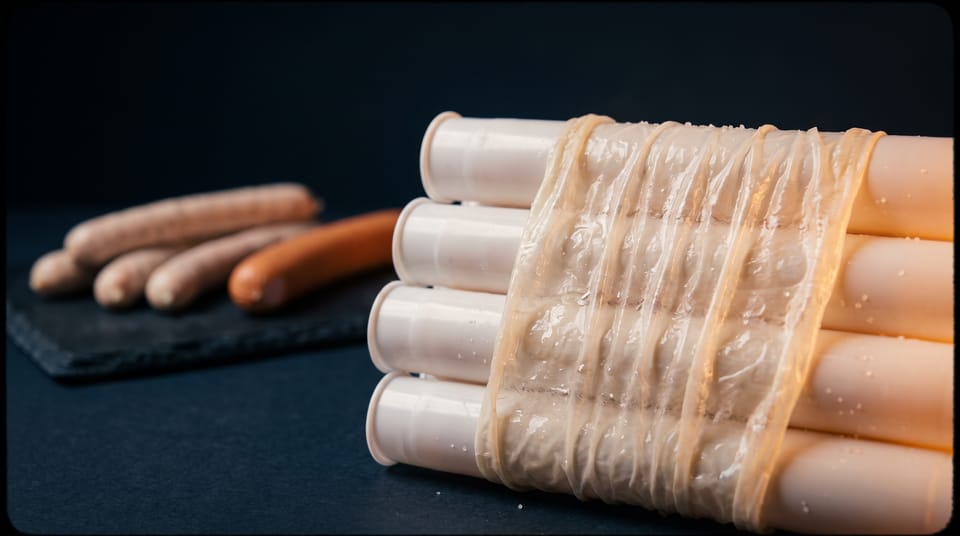
- Keep chilled until use. Soft tubes are packed in brine and must stay refrigerated. Do not freeze them.
- Short rinse or soak. Take the tubes for the shift out of the bucket and rinse or soak them briefly in clean water as stated on the datasheet, typically a matter of minutes rather than hours.
- Load. Push the tube over the horn, release the casing and withdraw the tube. The 7 to 16 metre sheep ends and 14 metre and more XXL hog ends run through without threading a wet casing.
Read more about the options in soft tubes versus salted bundles.
Typical ranges per species
| Species and make-up | Typical soak after rinsing | Water temperature | Notes |
|---|---|---|---|
| Sheep casings, salted | 30 to 60 minutes, or overnight chilled | About 20 to 30 °C | Thin wall; avoid warm or long soaking |
| Hog casings, salted | 30 minutes to 2 hours, or overnight chilled | About 20 to 30 °C | Flush each end; long ends need one flush per end |
| Beef rounds, middles, caps | Several hours to overnight chilled | Cool to lukewarm | Thick wall; turn inside out if required by the recipe |
| Any species on soft tubes | Short rinse or soak per datasheet | Cool | Do not freeze; keep in brine until use |
These are industry conventions and starting points. Water hardness, lot condition and room temperature move the figures, which is why the check in step 4 matters more than the clock.
Common faults and their causes
Casing bursts at the horn. Under-soaked or too cold; residual salt; horn too wide for the calibre. Check the fit in the calibre guide.
Sausage fills wider than the calibre class. Over-soaked or soaked too warm; filling pressure too high. Shorten the soak and check the pressure setting.
Salt taste or white spots in the finished product. Salt not rinsed off before soaking, or no inside flush.
Casing slips off the horn or wrinkles. Casing too wet and slack, or horn too narrow. Let the casing drip briefly before threading.
Safety note
Natural casings are a food ingredient. Potable water, clean basins, controlled temperatures, holding times and the separation of prepared casings from salted stock belong in your HACCP plan. The ranges in this article are typical for the industry and do not replace the product datasheet or your own validated procedure. Teijsen states the recommended preparation per product on the datasheet and checks every lot in Zeewolde under IFS Food Higher Level; see the quality page. If you want to test preparation on your own line, request a sample in your calibre and make-up.
Last updated: 5 October 2026